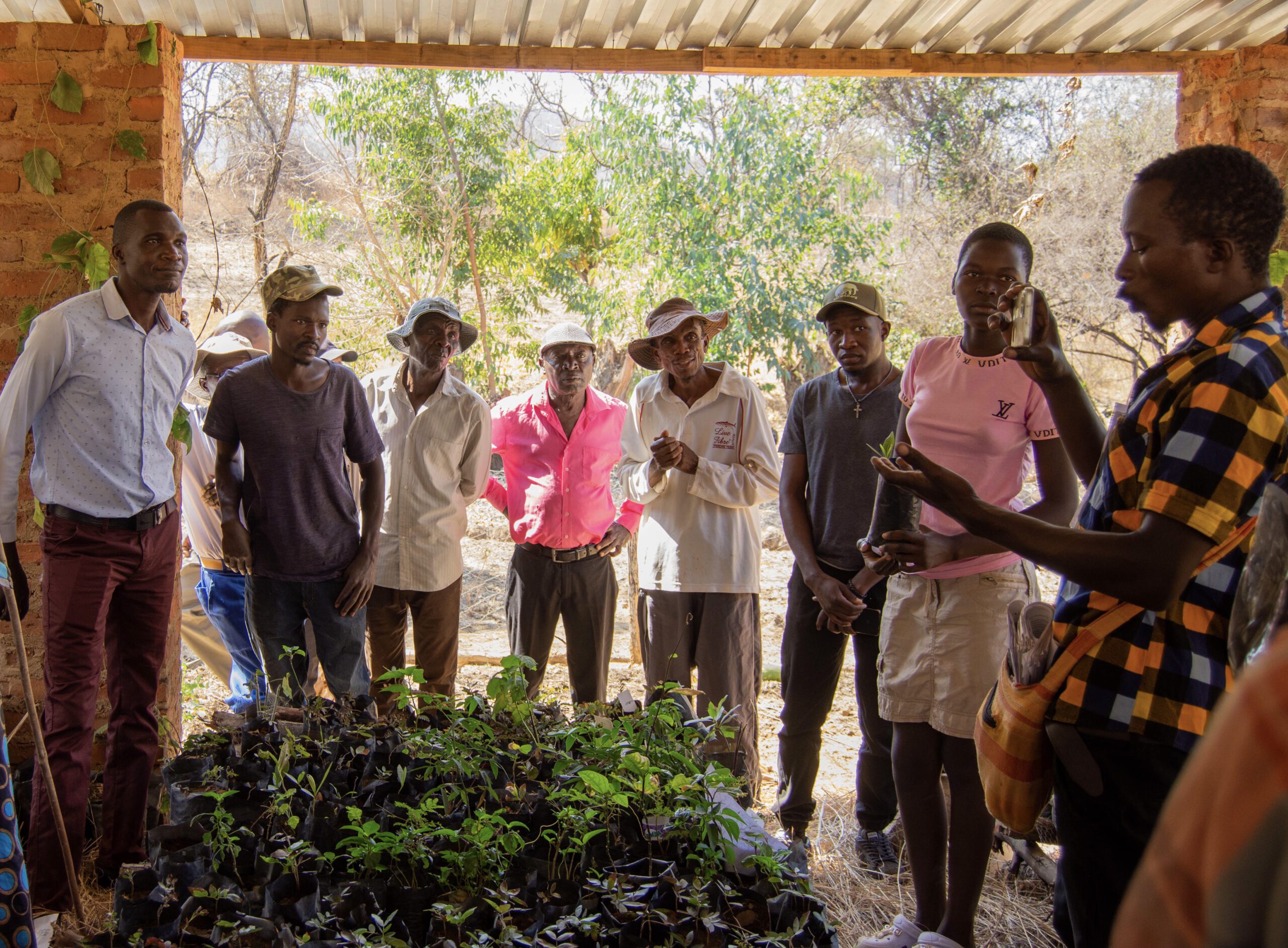
The project “Exploring and Exchanging Communications About Trees (EECAT)” was conceived with the purpose of embedding opportunities within the community for intergenerational and inter-professional discussions about the value of trees in this social / ecological setting. A small grant of £5000 from Bath Spa University, supported a 4 day permacultural training programme at the local Govera Primary School in 2023.
More than 40 participants including local community members, teachers, children, 3 teacher trainers from the University of Zimbabwe and the Trees of Hope project team attended staged learning events (June – October 2023) provided by Schools and Colleges Permaculture (SCOPE Zimbabwe) which culminated in the creation of a new tree nursery and growing area within the school grounds.
The University of Zimbabwe team documented these events through a participatory action research process in order to share the various voices of local community members about the significance of trees for their everyday lives and survival.
The written report was shared at an event ‘Young People and Climate Change’ (16 February 2024) organised by the Trees of Hope team at the nursery site. This was attended by village heads, elected councillors, representatives from the Ministry of Youth and the Environment Management Agency, the University of Zimbabwe team, the headteacher of Govera Primary School, children from Govera Primary and Secondary Schools and the Junior MP from the local High School.
As part of the funded EECAT initiative, activities that mirror the experience of Trees of Hope in Zimbabwe have been organised with children and teachers at Hennock Primary School, Devon, UK. Currently a Trees of Hope Newsletter, prepared for an audience of children is being shared weekly between the 2 participating schools and the Trees of Hope Saturday Club.
The EECAT project was planned through online meetings between team members from Bath Spa University, the University of Zimbabwe, permaculture trainers from SCOPE and Trees of Hope, UK. Six stages of the intervention and enquiry were identified as follows:
- Gathering: The ToH workers, teachers, children, local community members, SCOPE trainers and researchers join together
- Training: The SCOPE team engage these participants in a 4 day school based training
- Planning: The teachers, children and Trees of Hope workers plan a planting project in the school grounds with support from community members and the ToH team
- Implementing: The teachers, children and ToH workers implement the school planting project alongside the community members
- Consultation: The researchers and Trees of Hope team share the findings and seek feedback from all the local stakeholders
- Summarising: The researchers compile a final illustrated report which is shared with teachers at the school, community members and the children
The principles of participatory action research inform the documentation of the activities.
The following research questions provided a focus for the shared enquiries
‘In what different ways can trees be valued?
‘What are the main threats to the local forest environments?’
‘What responsibilities do local community members have to preserve / improve tree cover in the local environment?’
The various voices of the participants are captured through photographs and interviews that reflected their engagement in the activities and invited them to reflect again on their participation.